
Press Releases

KPF Review Hospitality: The Sociable City
As cities embrace mixed-use diversity and central business districts transform into central social districts, hotels and resorts have an important role to play in bringing vibrancy into the city center. The best of these projects establish themselves as new social hubs, creating connections between visitors and locals while blurring the boundaries between work and leisure.
Designing an Authentic Travel Experience for Today’s Cities
In cities around the world, locals and visitors alike seek out neighborhoods and districts that feel lively, authentic, and unique. Places such as Lower Manhattan in New York, Roppongi Hills in Tokyo, and Covent Garden in London, offer the opportunity to experience completely distinctive urban environments, each with their own aesthetic identity, blend of activities, and rhythm of daily life.

Though each of these places is unique, they share some traits in common. Blending historic fabric with contemporary insertions, they offer an abundance of variety to visitors and residents alike—you can find homes, offices, restaurants, shops, hotels, theaters, and parks in close proximity. This variety of uses attracts different groups of people at different times of day who come together to bring the district to life in what the great urbanist Jane Jacobs called the “ballet of the sidewalk.”
We think of these places as central social districts (CSDs), because unlike traditional central business districts (CBDs), which are almost entirely given over to commercial office space, their design prioritizes social interaction between human beings. When the office workers go home, the CBD goes dark. In the CSD, on the other hand, activity continues thanks to cultural venues, restaurants, homes, and hotels.

Cities around the world are undergoing a transformation from the CBDs of past generations to the CSDs of today, but to work effectively, these places need to be sociable; they need to invite people to linger, explore, and connect with one another. To do that, they must be hospitable; they must be comfortable, welcoming, and offer both interest and familiarity. Hotels are critical to the success of a CSD, impacting vibrancy and activity from day to night. By designing hotels to engage with their surrounding urban ecosystem, architects can create a more outward-facing experience that not only brings hotel visitors into closer contact with the city they are visiting, but also has something to offer the seasoned local, whether in the form of a buzzy restaurant, robust spa program, or convenient café.
At KPF, we also believe that hospitality extends beyond traditional hotels. Approaching the design of buildings within a central social district through the lens of hospitality changes how the district feels to people who use it every day, as well as to visitors. Openness, engagement with the public realm, flexible programming, and blurring the boundaries between public and private space are critical to making an urban environment feel sociable.
Blending Business and Leisure
To understand how hospitality design shapes cities today, it helps to think about why people travel in the first place. Since ancient times, travel has primarily taken two forms: business and leisure. The ancient world had its fair share of what we would now call work trips. These involved merchants moving luxury goods and commodities over distances both short and long, whether to nearby market towns or across the silk roads of Central Asia.

At the same time, travel also took on spiritual dimensions, with pilgrimage routes—undertaken by followers of many different religious traditions—emerging as key vectors of cultural exchange. Today, the way we travel looks very different, but the reasons we go are more or less the same. We travel for work and we undertake more mindful journeys to connect with a particular culture, environment, or experience that we cannot access at home.
Though individual travelers are typically either on the move for business or leisure, most hotels cater to a mix of both types of guests. A hotel in a major city center that is popular with business people because of its location, brand, or conference facilities may also be popular among tourists who come for access to cultural attractions.

Similarly, a destination resort that is popular with tourists may also be equipped with facilities to host business conferences and retreats. In this way, hotels and resorts represent the CSD experience in microcosm by blending environments for business and leisure.
We can look at the work/leisure spectrum not only in terms of multi-day trips, but also people’s day-to-day activities. Through this lens, office workers might enjoy a café or bar that’s integrated into a commercial building’s lobby or students may use a dormitory’s lounge spaces for studying. By applying elements of hospitality design to retail, residential, and workplace environments, we create spaces that invite building users to linger. These interventions can be relatively subtle, such as a warmer material palette, updated amenities, or public realm interventions, but when applied broadly across a given area of the city, they can change the texture of a district and give locals and visitors alike reasons to spend their most precious asset—their time.

Urban Retreats
Designed for seclusion and comfort, urban retreats comprise a class of hotels located in some of the world’s most vibrant city centers but offer a reprieve from the hustle and bustle of city life.
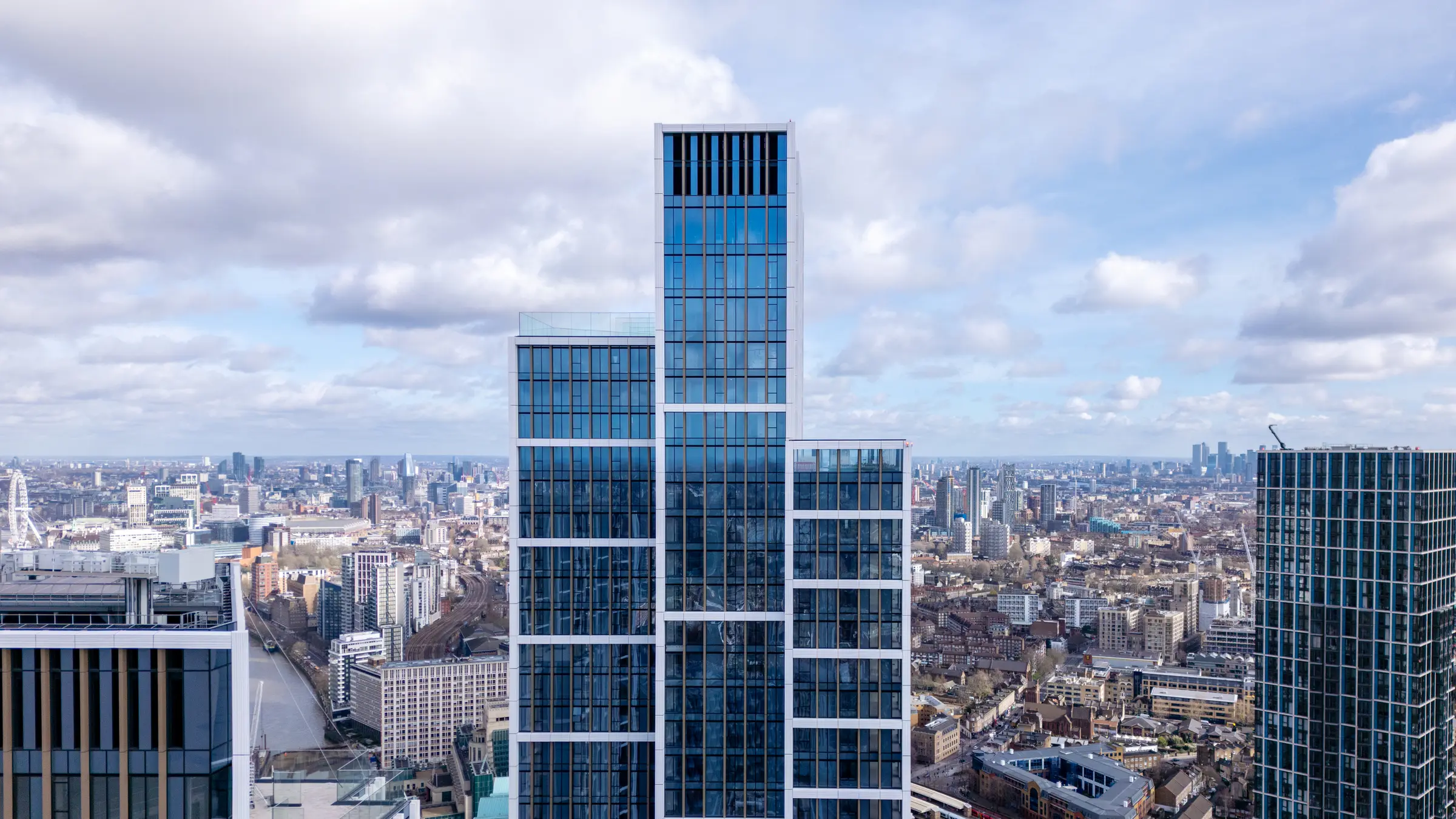
The two buildings of the One Nine Elms development in London, for example, occupy a landscaped, waterfront site on the River Thames. In China, KPF’s design for the Park Hyatt Suzhou draws from that city’s classical gardens to craft a verdant urban oasis that brings greenery into the guest experience while connecting to a nearby park. The Bulgari Hotel in Beijing, a component of the larger Genesis Beijing development, takes a similar tack. With an architectural language defined by the solidity of stone and a private, waterfront garden, the hotel offers a refuge within the activity of greater Beijing. At the Rosewood Bangkok, an angular tower and private sky gardens come together to offer guests a serene hospitality experience that floats above one of Asia’s most dynamic capitals.
The Aman Tokyo takes the idea of an urban retreat to the extreme. Accessed from a sky lobby within the 38-story Otemachi Tower in one of Tokyo’s premier business districts, the hotel offers unparalleled spa experiences with a uniquely Japanese approach to hospitality, but is only hinted at from the street by cutouts in the building’s otherwise rational massing. Blending iconicity with sophistication, hotels of this kind distill local cultural and aesthetic references into a highly refined package where guests feel as though they have discovered a hidden world within the city.




Downtown Energy
Located in some of the world’s most exciting downtown districts, hotels that connect to local energy and amenities welcome visitors to experience all that their host cities have to offer.
These projects can be standalone hotels or incorporated into mixed-use projects, but all are dynamic and outward facing, connecting guests to the city while inviting locals in with public amenities such as bars and restaurants.
From Austin, Texas’s One Hotel, located within the city’s tallest building, to the boutique hotel within London’s One Crown Place, these hotels can be great bases from which to explore a city’s cultural attractions. They can also be sensitively integrated into a city’s historic fabric, such as the Langham and Andaz Hotels in Xintiandi, Shanghai, which complement the neighborhood’s traditional architecture, while supporting its transformation into a retail destination.
The Landmark Mandarin Oriental, in Hong Kong’s lively Central district, accomplishes a similar feat of connection through multi-level links to the Landmark shopping mall. The Conrad New York, a deftly executed adaptation of an out-of-date hotel building, creates new street-front shopping and dining opportunities as well as a significant public atrium. Located within and contributing to the central social districts of highly dynamic, global cities, these hotels cater not only to business travelers, but also to guests who are looking to connect with the city through food, art, music, and other cultural experiences.


Luxury Lifestyle Districts
These hotels form the nucleus of new mixed-use lifestyle districts that attract upscale clientele with amenities, workplaces, shopping, and other attractions.
Within these neighborhoods, hotels take on a number of different roles. Several serve as iconic landmarks that distinguish the development on the skyline. The River Oaks Hotel in Houston, Texas, translates the local suburban aesthetic into a vertical form to establish a new heart for the surrounding district. With its stepped massing and expressive finishes, the Rosewood Tower in Hong Kong anchors the unique art and design district of Victoria Dockside.
At the Parkside Seoul, an entire new city district, complete with a mix of office, residential, retail, and officetel buildings, a centrally located hotel establishes a distinguishing focal point within the neighborhood by connecting to the main retail axis through vertically incorporated greenery. In other locales, the hotel component may complement other typologies as diverse as residential, retail, or workplace, such as at Suzhou China Central Place. In all of these environments, the hotel becomes more than a place to stay, establishing itself as a key component of the district’s identity and lifestyle offering, supporting a vibrant, active place where people are excited to spend their time.


Urban Resorts
From resorts located within urban lifestyle districts to waterfront and mountaintop destinations that contain within themselves a unique sense of urbanity, these projects respond to their local context and visitors’ desires with elegant design and thoughtful programming.
The Residences at Mandarin Oriental, Miami, which features both high-end homes and a Mandarin Oriental hotel, occupies an island site overlooking the Miami skyline and Biscayne Bay. Offering resort amenities and easy connections to downtown Miami, its unique silhouette establishes its presence on the city’s dynamic skyline. The Mandarin Oriental in Tel Aviv similarly mediates between that city’s dynamic urbanism and its lively beachfront, while offering guests a private, raised pool deck from which to experience the skyline and the azure waters of the Mediterranean.
A Waldorf-Astoria hotel underway in Deer Valley, Utah, connects the slopes to an alpine village, creating a sophisticated wrap-around experience virtually unique among North American ski resorts. Atlantis The Royal, in Dubai, meanwhile, occupies an unrivaled site on an artificial island; the building’s unique massing allows for plentiful private terraces from which guests and residents can take in views of Dubai’s skyscrapers and the sea.
At KPF, we believe that the best resorts bridge the divide between nature and city, contravening simple dualisms and outdated categories to deliver unrivaled guest experiences.


Hospitality Beyond Hotels: Making Third Places
KPF is applying the lessons of hospitality design to projects from offices to universities, making the world a more welcoming place.